Biology Pre-Assessment
Quiz Summary
0 of 67 Questions completed
Questions:
Information
You have already completed the quiz before. Hence you can not start it again.
Quiz is loading…
You must sign in or sign up to start the quiz.
You must first complete the following:
Results
Results
0 of 67 Questions answered correctly
Your time:
Time has elapsed
You have reached 0 of 0 point(s), (0)
Earned Point(s): 0 of 0, (0)
0 Essay(s) Pending (Possible Point(s): 0)
Categories
- Biochemistry 0%
- Cellular Biology 0%
- Ecology 0%
- Evolution 0%
- Molecular Biology 0%
- Organismal Biology 0%
-
Congratulations- you have completed this assessment.
The goal is to give you valuable feedback on your grasp of different topics that are taught in a non-majors Biology course. Use this information to chart your path through your education!
- 1
- 2
- 3
- 4
- 5
- 6
- 7
- 8
- 9
- 10
- 11
- 12
- 13
- 14
- 15
- 16
- 17
- 18
- 19
- 20
- 21
- 22
- 23
- 24
- 25
- 26
- 27
- 28
- 29
- 30
- 31
- 32
- 33
- 34
- 35
- 36
- 37
- 38
- 39
- 40
- 41
- 42
- 43
- 44
- 45
- 46
- 47
- 48
- 49
- 50
- 51
- 52
- 53
- 54
- 55
- 56
- 57
- 58
- 59
- 60
- 61
- 62
- 63
- 64
- 65
- 66
- 67
- Current
- Review
- Answered
- Correct
- Incorrect
-
Question 1 of 67
1. Question
Category: BiochemistryScientists have strict rules about how to gather data. One such rule involves the units used to report that data. What system do scientists use the world over?
-
Question 2 of 67
2. Question
Category: BiochemistryKnowing about the subatomic particles helps us understand how the different elements will react. Which of the following subatomic particles has a negative charge?
-
Question 3 of 67
3. Question
Category: BiochemistryAtoms and ions of the same element can have very different chemical reactivities. What kind of charge would an atom have?
-
Question 4 of 67
4. Question
Category: BiochemistryAtoms are ordered into various structures that make up living organisms. How do atoms react chemically?
-
Question 5 of 67
5. Question
Category: BiochemistryThe atomic number for carbon is 6. If you find an atom of carbon-13, how many protons, neutrons and electrons does it have?
-
Question 6 of 67
6. Question
Category: BiochemistryThe valence electrons of an atom determine its chemical reactivity. Calcium has two valence electrons while chlorine has seven. What are the charges on calcium ions and chloride (an ion of chlorine)?
-
Question 7 of 67
7. Question
Category: BiochemistryIonic bonds play important roles in our physiology. Which of the following statements about ionic bonds is correct?
-
Question 8 of 67
8. Question
Category: BiochemistryCovalent bonds help form the structures of life. Which of the following statements about covalent bonds is correct?
-
Question 9 of 67
9. Question
Category: BiochemistryCarbohydrates are the main energy source for living organisms. Which of the following organisms are able to make their own carbs?
-
Question 10 of 67
10. Question
Category: BiochemistryThe four macromolecules are the keys to life as we know it, but only three of them form polymers. Which of the following statements properly pairs the macromolecules that form polymers with their subunits?
-
Question 11 of 67
11. Question
Category: BiochemistryProtein means “first importance” — this is because proteins perform so many different functions in living organisms. Proteins have some similarities with carbohydrates, but some important differences too. What element do proteins have that carbohydrates lack?
-
Question 12 of 67
12. Question
Category: BiochemistryThe two nucleic acids (DNA and RNA) tell our cells what proteins to make. How does DNA store this genetic code?
-
Question 13 of 67
13. Question
Category: BiochemistryLipids can store energy, serve to insulate and absorb shocks, and form most of the cell membrane. What characteristic of phospholipids in the cell membrane help them create a phospholipid bilayer?
-
Question 14 of 67
14. Question
Category: Cellular BiologyThe Cell Theory helps us understand important ideas about what cells are and what they can do. Which of the following choices correctly states parts of the cell theory?
-
Question 15 of 67
15. Question
Category: Cellular BiologyCells are the fundamental unit of life. What structure serves to separate the internal environment from the external environment of the cell, regulates what enters and leaves the cell, and provides sensitivity to the environment?
-
Question 16 of 67
16. Question
Category: Cellular BiologyCells work hard getting the necessary substances in and out of their cell membranes. Which of the following statements correctly describes how cells transport substances across their membranes?
-
Question 17 of 67
17. Question
Category: Cellular BiologyOut of all the cells in the world, there are actually only two categories. What is the main difference between prokaryotes and eukaryotes?
-
Question 18 of 67
18. Question
Category: Cellular BiologyPerhaps the single most important job of a cell is the production of proteins. What structure stores the information on how to make the proteins and what structure actually assembles the proteins?
-
Question 19 of 67
19. Question
Category: Cellular BiologyAll living things can perform cellular respiration. What is the purpose of cellular respiration?
-
Question 20 of 67
20. Question
Category: Cellular BiologyWhile aerobic cellular respiration is quite complicated, most of it occurs in one place. What is the name of the organelle where aerobic cellular respiration occurs?
-
Question 21 of 67
21. Question
Category: Cellular BiologyOur cells can break down carbohydrates using cellular respiration or fermentation. What is a difference between cellular respiration and fermentation?
-
Question 22 of 67
22. Question
Category: Cellular BiologyPhotosynthesis allows photoautotrophs to form the biomass necessary for life on earth. What is one of the products of photosynthesis?
-
Question 23 of 67
23. Question
Category: Cellular BiologyThe cell cycle shows the process a cell usually goes through as it grows and divides. What part of the cell cycle do most cells spend most of their time in?
-
Question 24 of 67
24. Question
Category: Cellular BiologyCell division is a complicated process, but there are only two main steps: mitosis and cytokinesis. What are the differences between mitosis and cytokinesis?
-
Question 25 of 67
25. Question
Category: Molecular BiologyIf the inheritance of a single gene represented by the letter A follows a simple dominant/recessive pattern, which of these is true?
-
Question 26 of 67
26. Question
Category: Molecular BiologyIn the experiments done by Gregor Mendel, he determined that sweet pea plants have purple or white flowers, and purple is the dominant trait. If a plant that is homozygous dominant for purple flowers is crossed with a plant that is homozygous recessive for white flowers, what prediction can we make about their offspring?
-
Question 27 of 67
27. Question
Category: Molecular BiologyEach gene represents a trait, and the appearance of an individual is a combination of the effects of all the genes it carries. In a diploid organism, such as most animals, two copies of each gene are inherited. How do those two copies combine to produce the observable trait?
-
Question 28 of 67
28. Question
Category: Molecular BiologyIf a trait is said to be Y-linked, which of these are true?
-
Question 29 of 67
29. Question
Category: Molecular BiologyCell division is an important process in all organisms, but not all cell division is the same. What is the goal of meiosis in animals?
-
Question 30 of 67
30. Question
Category: Molecular BiologyDNA is a popular subject on science shows, but how is it structured? Choose the best description of DNA.
-
Question 31 of 67
31. Question
Category: Molecular BiologyAlmost every cell in your body requires its own copy of your genetic code. What is DNA replication?
-
Question 32 of 67
32. Question
Category: Molecular BiologyMaking proteins is perhaps the single most important thing cells do. How are proteins made in a cell?
-
Question 33 of 67
33. Question
Category: Molecular BiologyWhen you have to make trillions of copies of your DNA, sometimes mistakes happen. Which of these is true for genetic mutations?
-
Question 34 of 67
34. Question
Category: Molecular BiologyGenetics can be a complicated subject with many different possible outcomes. When studying heredity, what does it mean to say that two genes are “linked”?
-
Question 35 of 67
35. Question
Category: Molecular BiologyBiotechnology is one of the fastest growing sectors of the US economy. What is Biotechnology?
-
Question 36 of 67
36. Question
Category: EvolutionThe world has been around for about 4.5 billion years and has seen a lot of things. Put these events in the appearance of life on Earth from earliest (first to appear) to latest (last to appear).
-
Organic molecules
-
Eukaryotes
-
Abundant oxygen
-
Proto-cells
-
Prokaryotes
View Answers:
-
-
Question 37 of 67
37. Question
Category: EvolutionThe first life on Earth dates from at least 3.7 billion years ago. Which of these is believed to be the first cell type to form on Earth?
-
Question 38 of 67
38. Question
Category: EvolutionComplete the sentence:
The 19th century naturalist __________ is well known for his observations of subtle differences between organisms in _______________ that led to an understanding of how species evolve.
-
Question 39 of 67
39. Question
Category: EvolutionNot all evidence that scientists discover is relevant. Which of these does not support the theory of evolution by itself?
-
Question 40 of 67
40. Question
Category: EvolutionWe have found fossils that are very old, even billions of years old. How do scientists determine the absolute age of an ancient specimen?
-
Question 41 of 67
41. Question
Category: EvolutionNot all organisms survive at the same rates. Choose the statement that is the best example of natural selection.
-
Question 42 of 67
42. Question
Category: Evolution
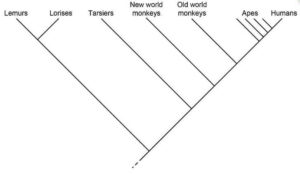
Scientists organize their information in a variety of ways.
What is this diagram and what is it used for? -
Question 43 of 67
43. Question
Category: EvolutionWe often use the term “species” in casual speech, but it doesn’t always have the same meaning as when scientists use it. In biology, what is the definition of a species?
-
Question 44 of 67
44. Question
Category: EvolutionEvolution is one of the foundational ideas in all of biology. Which statement regarding evolution is false?
-
Question 45 of 67
45. Question
Category: EvolutionScience provides many tools to study populations. How is the Hardy-Weinberg equation used in the study of evolution?
-
Question 46 of 67
46. Question
Category: EcologyIn studying relationships between organisms and the environment, ecologists describe levels of organization. Which answer lists the levels of organization from the largest to smallest?
-
Question 47 of 67
47. Question
Category: EcologyWhile some organisms can get their energy from chemical means, most producers rely on something else as a source of energy. What is the primary energy source for life on earth?
-
Question 48 of 67
48. Question
Category: EcologyComplete the sentence:
In an ecosystem, energy _______ from one organism to another and the most of the biomass exists in _________.
-
Question 49 of 67
49. Question
Category: EcologyCertain elements are required for life to exist, but not all are easily accessible. Complete the sentence:
The most abundant element in Earth’s atmosphere is ________ and it enters an ecosystem by ________.
-
Question 50 of 67
50. Question
Category: EcologyEvery organism has its own unique way of using resources and interacting with the environment it lives in (the role it plays in the environment). What term describe this concept?
-
Question 51 of 67
51. Question
Category: EcologyThe earth is divided into different climate zones. Which climate zone has the widest variation in temperatures in a year and experiences four seasons?
-
Question 52 of 67
52. Question
Category: EcologyBiomes are just one of several levels of ecological organization. What is a biome?
-
Question 53 of 67
53. Question
Category: EcologyThe Earth is a big place, but more than half of the surface is dominated by one zone. Which of these occupies the most area on the Earth?
-
Question 54 of 67
54. Question
Category: EcologyPopulations grow and decline, and sometimes disappear. Which of these will not directly affect the size of a population?
-
Question 55 of 67
55. Question
Category: EcologyAnimals in the genus Galago are commonly known as bush babies. These small primates are known to have large eyes and ears, long tails, and strong hands.
Based on these characteristics, which of these is not a behavioral adaptation of bush babies?
-
Question 56 of 67
56. Question
Category: EcologyHuman population has grown dramatically since the late 19th century. Which of these events was not a contributor to the dramatic change in success of humans in that time period?
-
Question 57 of 67
57. Question
Category: EcologyFossil fuels have been able to provide us with a stable and plentiful source of energy. What is the major drawback to fossil fuels?
-
Question 58 of 67
58. Question
Category: Organismal BiologyIt can sometimes be difficult to tell if something is alive, but scientists have listed the characteristics that all life shares. Which of these is not a criterion that a biologist would use to determine if something is alive?
-
Question 59 of 67
59. Question
Category: Organismal BiologyOrganisms have levels of organization. Which list shows the correct levels of organization for an animal, from smallest to largest level?
-
Question 60 of 67
60. Question
Category: Organismal Biology
When studying the human body, it helps to divide it into different planes for reference. In the figure, which plane is represented by the letter “a”?
-
Question 61 of 67
61. Question
Category: Organismal BiologyUsing anatomical terms to describe the location of one structure as it compares to another structure is a key part of how scientists talk about the body. Which statement describing the orientation of structures is correct?
-
Question 62 of 67
62. Question
Category: Organismal BiologyOne of the characteristics of life is homeostasis. Which is the best definition of homeostasis?
-
Question 63 of 67
63. Question
Category: Organismal BiologyThe body maintains homeostasis using self-regulating control systems, often referred to as loops. Which of these is an example of a positive feedback loop in the body?
-
Question 64 of 67
64. Question
Category: Organismal BiologyOrgans that work together to perform a specific function in the body are grouped together in organ systems. Which of these is an incorrect pairing of an organ with its organ system?
-
Question 65 of 67
65. Question
Category: Organismal BiologyOrgan systems all have different roles to play in our bodies. Which is the best description of the purpose of the cardiovascular system?
-
Question 66 of 67
66. Question
Category: Organismal BiologyThe prefix “hypo-” shows up in many medical terms, like hypodermic needle or hypothermia. What does this prefix mean?
-
Question 67 of 67
67. Question
Category: Organismal BiologyThe calf muscle in the leg is called the gastrocnemius. What does “gastro-” refer to in medicine?